Connecting and Communicating Your Ideas: Purposeful Learning
Professional Learning Planning: Empowering Teachers to Bring Hybrid Learning
In this professional learning journey, we seek to create spaces where teachers feel supported to grow, reflect, and transform their instructional practice. In that spirit, Go & Show serves as the starting point for this Professional Learning Planning, an approach that invites second-grade teachers to be inspired, connect instruction with authentic experiences, propose new strategies, value their professional voice, and build a collaborative pathway for growth. This vision is enriched by the contributions of several key authors: Harapnuik (2016) reminds us through the COVA model that learning becomes meaningful when teachers have choice, ownership, voice, and authentic opportunities to apply new ideas. Fink (2013) emphasizes that deep learning emerges when teachers actively participate, reflect, and integrate new knowledge into real practice. Gulamhussein (2013) offers clarity on what makes professional learning effective by highlighting the importance of ongoing support, extended duration, active participation, modeling, and content aligned to specific grade-level needs. Duarte (2010) encourages us to communicate ideas that inspire possibility and move people toward a shared vision. With these foundations, this process seeks to strengthen reading and writing instruction in second grade through professional learning that is dynamic, reflective, and grounded in continuous improvement. In this professional learning journey we have built a vision that places teachers at the center, recognizing them as professionals who think, experiment, reflect, and continuously refine their instructional practice. This vision is strengthened by authors who challenge us to see learning through a lens that is more human, more intentional, and more deeply connected to real classroom practice.
Grounded in these foundations, we understand that our work is not only to deliver training but to create constructive spaces that motivate teachers, capture their interest, and invite them to explore, question, and grow. Spaces where learning feels alive and purposeful. Spaces where teachers feel supported, valued, and empowered to transform their practice. This is why Go & Show becomes our starting point. It invites us to turn learning into a living and shared experience, where every teacher can see, feel, and demonstrate the impact of their own growth. And now, with this vision clarified and a strong foundation beneath us, we reach the moment that matters most: continuing to listen, continuing to move forward, and continuing to transform.
Call to Action: An Invitation to Learn, Grow, and Transform Together.

The 5 key principles of effective PL
Audience: The Educators at the Heart of This Transformation
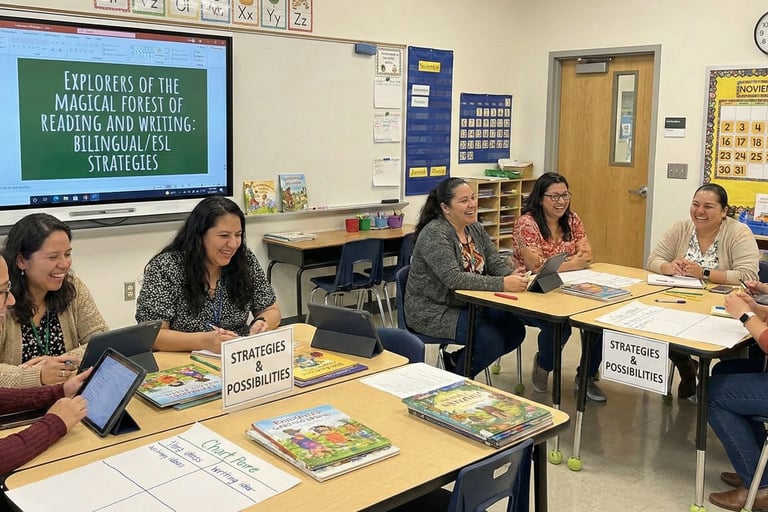
The primary audience for this Professional Learning includes elementary teachers, particularly second-grade educators working in bilingual or ESL environments. These educators play a key role in early literacy development and support students as they build skills to read and write in two languages. It also includes participants in the Explorers of the Magical Forest of Reading and Writing program, teachers committed to creating learning experiences that are meaningful, enriching, and responsive to their students’ needs. By focusing on those who directly influence foundational literacy skills, this Professional Learning Planning aims to provide strategies and collaborative spaces that support, expand, and strengthen teaching practice, not by prescribing a single approach, but by opening possibilities to explore what works best in each classroom context.
When Needs Become Opportunities for Transformation
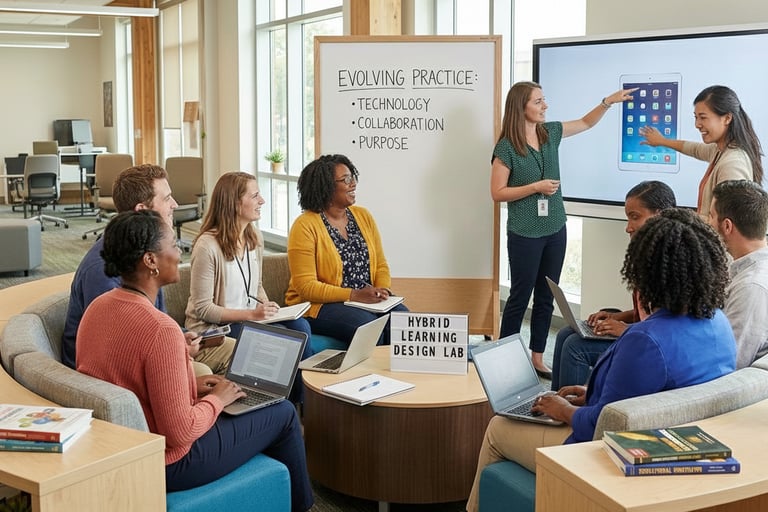
In a continually evolving school environment, new opportunities emerge to transform our practice in intentional, human-centered ways. From everyday conversations, interests surface that open meaningful paths of exploration: integrating technology more thoughtfully into reading and writing; designing hybrid experiences that align with the school’s real resources; building digital confidence through modeling and guided practice; creating ongoing collaborative spaces to share progress, questions, and insights; and reconnecting with the deeper purpose that gives meaning to teaching and educational innovation. These needs are not deficits but invitations, opportunities to keep growing together, to imagine new ways to support our students, and to create environments where learning becomes a meaningful experience for everyone.
Goals That Inspire Us to Grow and Transform Together
The goals of this Professional Learning aim to drive concrete actions that strengthen teaching practice. They seek to design learning experiences aligned with classroom realities, model strategies that can be seen and replicated, implement new ideas gradually and authentically, reflect openly on outcomes and insights, and adjust practices with flexibility to meet students’ needs. These goals support a continuous growth process, allowing each educator to move forward according to their style, experience, and purpose, creating the conditions for children to build strong reading and writing skills and experience learning in more meaningful ways.
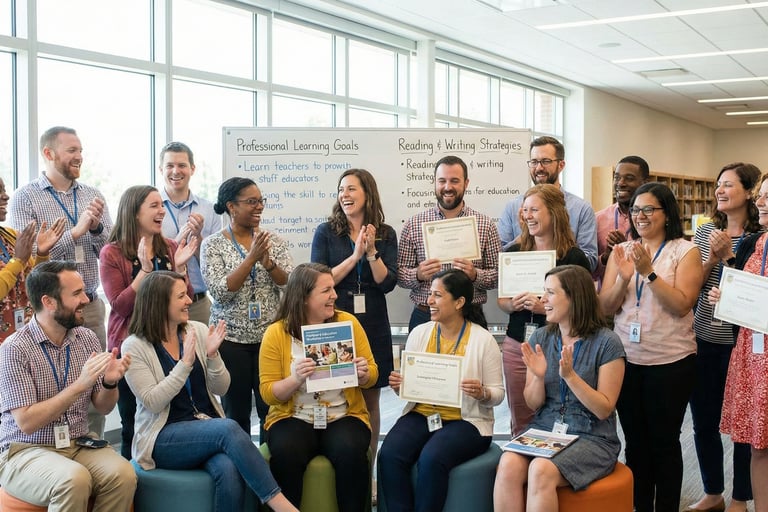
Bringing Vision Into Action: Our BHAG and Three-Column Guide
In this Professional Learning, we use a guide that connects the BHAG and the Three-Column Table to keep a clear link between the vision that inspires us and the actions that help us move forward. This structure allows us to align what we hope to achieve with the steps we will explore and with simple ways to recognize progress along the way. It is based on design approaches that connect intention with action and promote meaningful learning experiences (Fink, 2003). By using this guide, the process becomes more visible, organized, and accessible, strengthening our commitment to supporting reading and writing in second grade with intentionality, coherence, and a focus on growth.
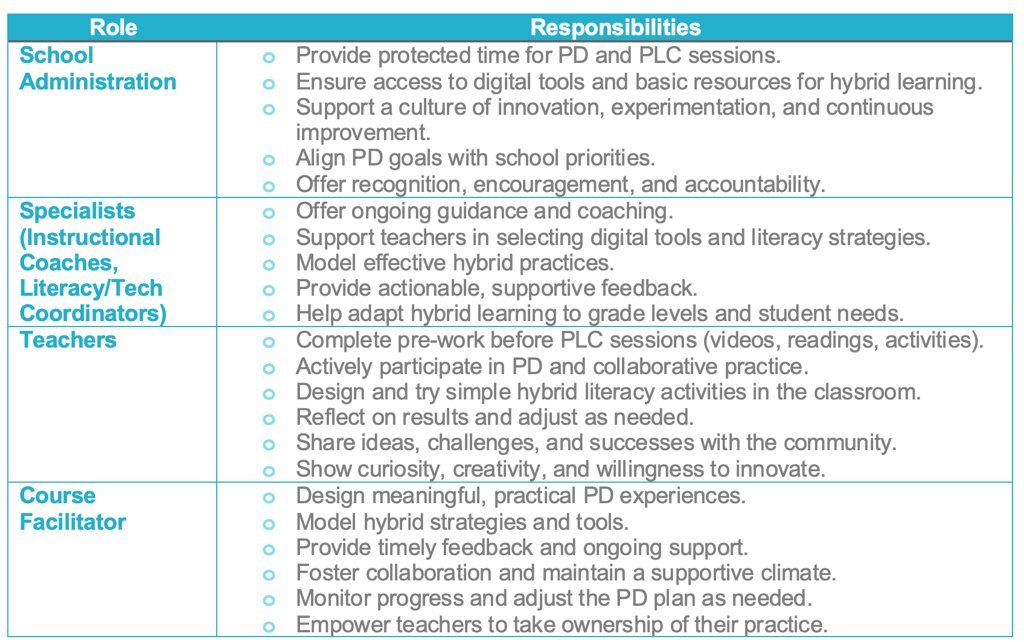
Effective professional learning is a shared responsibility. Each member of our school community plays a key role in supporting hybrid learning, from leadership to specialists, teachers, and the course facilitator. This framework outlines the contributions of each role to ensure our PD process is collaborative, purposeful, and sustainable.
Roles & Responsibilities. Professional Development
Timeline of the Professional Learning Implementation Plan
Professional Learning: Modules That Connect Vision to Practice
The Professional Learning we propose grows from a genuine commitment to supporting teachers in their development, acknowledging their experiences, contexts, and the lived reality of their classrooms. It is a shared process where we explore how hybrid learning can strengthen second-grade reading and writing, integrating technology with purpose and sensitivity. This approach draws on ideas that have inspired educators around the world: the importance of creating authentic and meaningful learning experiences, as highlighted by Fink (2003); the value of connecting vision with action through intentional design, as proposed by Wiggins and McTighe (2005); and the invitation to create environments where teachers have voice, choice, and real opportunities to act, following the perspectives of Harapnuik and Thibodeaux (2016). It is also guided by evidence showing that effective professional learning requires continuity, support, and active participation, principles emphasized by Gulamhussein (2013).
Across six connected modules, teachers will explore new ideas, design hybrid experiences, apply strategies in their classrooms, and reflect on the results to refine their practice. The intention is for every educator to feel supported and valued, and for this process to empower them to create experiences that inspire children to read, write, think, and discover. This Professional Learning does not aim to prescribe a single model but to open possibilities and strengthen our community’s capacity to keep growing together.
The Role of Learning Communities in Professional Growth
Learning communities provide a space where educators can grow together, reflect on their practice, and co-construct meaningful solutions. Their real power lies in connecting each teacher’s voice and experience to a shared purpose. As DuFour et al. (2016) emphasize, an effective PLC is not simply a meeting but a culture where shared reflection, peer feedback, and collaborative practices lead to sustained improvements in teaching.
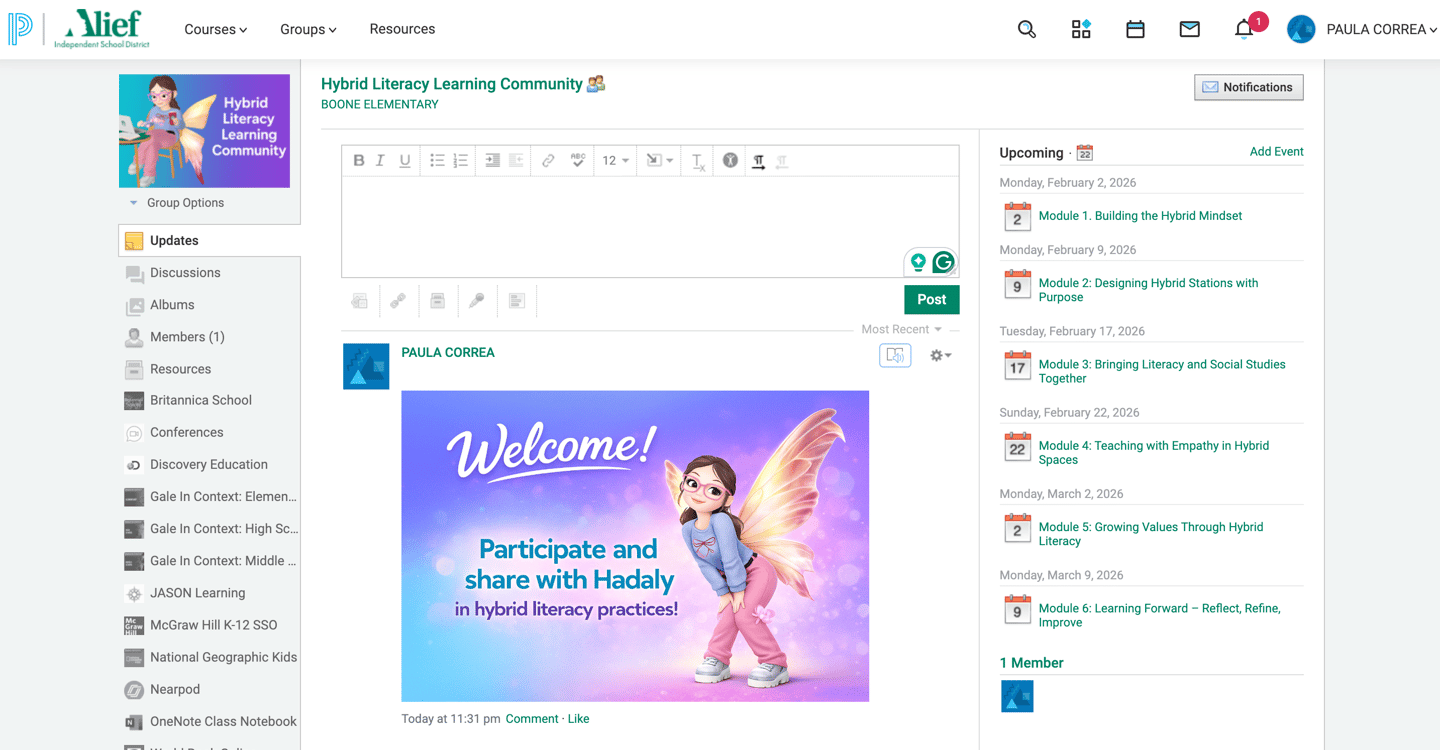
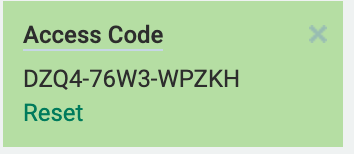
With this spirit in mind, we invite teachers to join our Hybrid Literacy Learning Community on Schoology, a collaborative space designed to support collective growth and authentic dialogue. Here, educators can share ideas, explore hybrid strategies, engage in reflective conversations, and strengthen their instructional practice through meaningful collaboration. Through this lens, our learning community becomes a catalyst for continuous growth and enhancing teacher confidence, building collective knowledge, and ultimately enriching student learning.
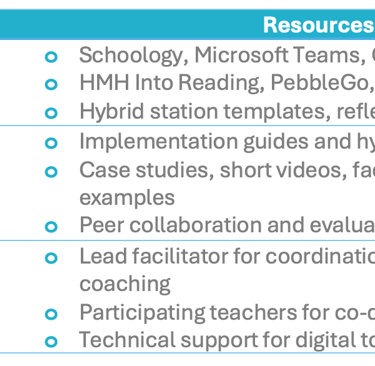
Resources That Elevate Teaching & Learning

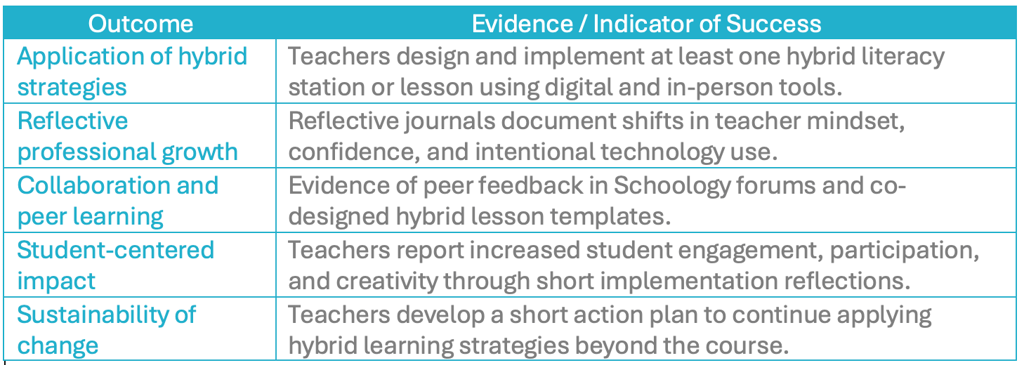
Expected Outcomes & Indicators of Success
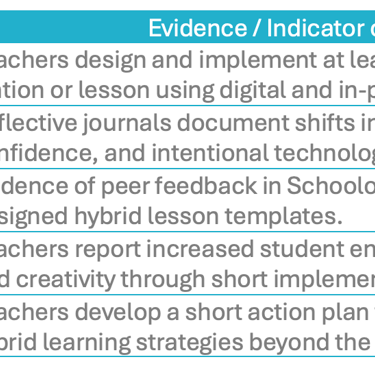
In this plan, measurement is understood as an ongoing process of monitoring and support that allows us to recognize, gently and openly, how strategies are growing and how teaching practices are evolving. Rather than evaluating, the intention is to understand what is emerging: more intentional pedagogical decisions, a more natural connection between digital and hands-on experiences, and students moving through the Forest stations with greater curiosity. Following the ideas of Gulamhussein (2013) and Fink (2013), this kind of follow-up helps us observe learning as something that unfolds over time, without rush or rigid expectations. Data, classroom observations, and everyday conversations serve as a flexible guide that helps us notice progress, make adjustments when needed, and strengthen what is already working. Ultimately, measurement becomes a way to recognize teacher growth and to understand the effectiveness of the Professional Learning process as a living, shared, and continually evolving process.


Let’s continue building this journey together, acknowledging that each step can open new possibilities for our practice and for our students. What makes this process meaningful is that we move forward as a community, sharing ideas, exploring new approaches, and supporting one another as we discover teaching practices that feel more authentic and purposeful. This is not an ending but an invitation to keep learning with curiosity, openness, and the intention to grow at our own pace and in partnership with others.

REFERENCES
Darling-Hammond, L., Hyler, M. E., & Gardner, M. (2017). Effective teacher professional development. Learning Policy Institute.
Duarte, N. (2010). Resonate: Present visual stories that transform audiences. Wiley.
DuFour, R. B., DuFour, R., Eaker, R., & Many, T. (2016). Learning by doing: A handbook for Professional Learning Communities at Work (3rd ed.). Solution Tree Press.
Fink, L. D. (2013). Creating significant learning experiences: An integrated approach to designing college courses (2nd ed.). Jossey-Bass.
Gulamhussein, A. (2013). Teaching the teachers: Effective professional development in an era of high stakes accountability. Center for Public Education.
Harapnuik, D., & Thibodeaux, T. (2016). The COVA model: Creating significant learning environments for authentic student learning. Lulu Press
Sinek, S. (2009). Start with why: How great leaders inspire everyone to take action. Portfolio
Wiggins, G., & McTighe, J. (2005). Understanding by design (2nd ed.). ASCD.